
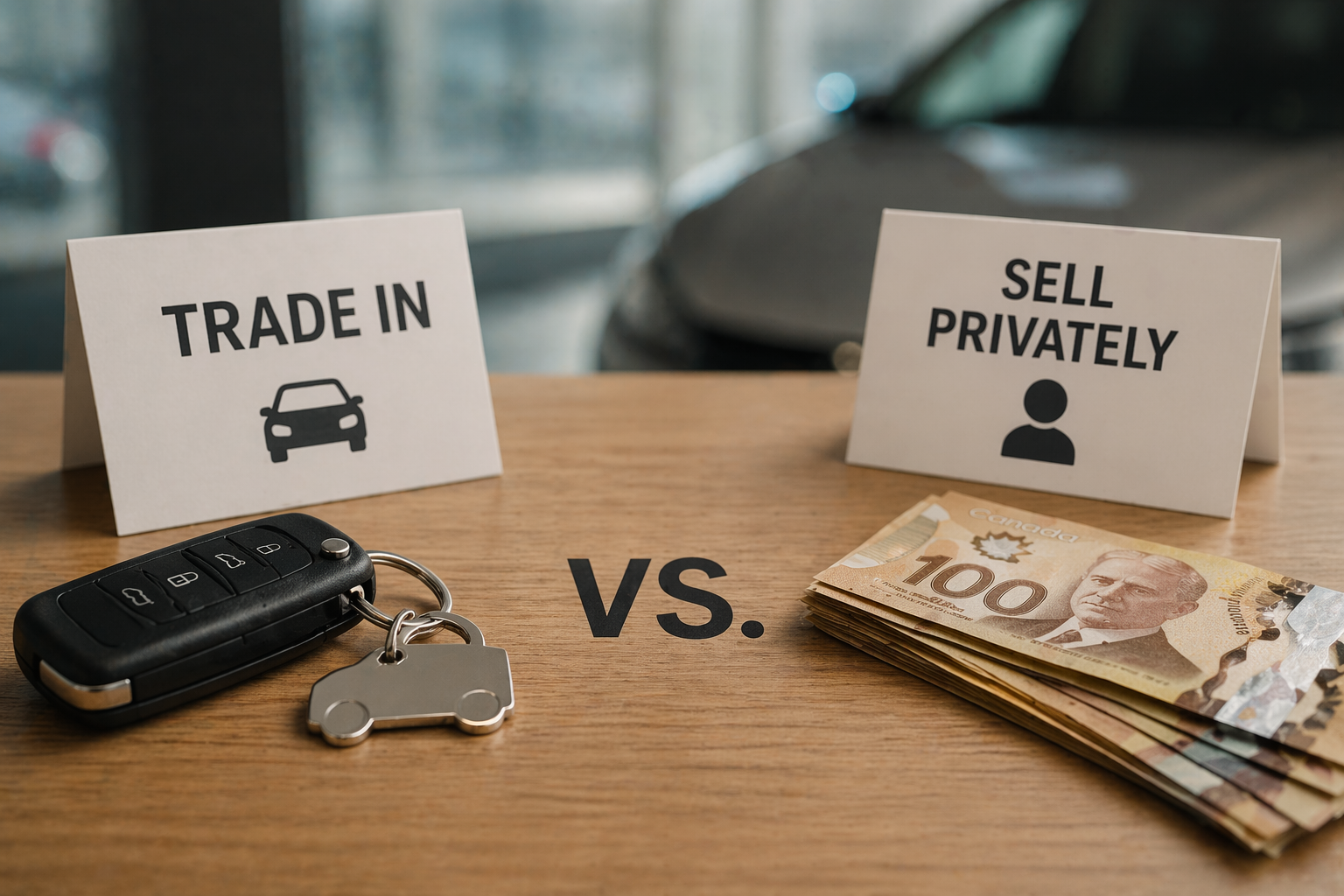
Trading In vs Selling Privately in Ontario: Which Actually Saves You More?
By David Carsmenskii · Canadian Car Buying · Reading time: ~4 minutes
TLDR: It depends on two things most buyers never factor in — the HST savings from trading in (13% of your trade value in Ontario), and how much time you actually want to spend selling a car. On paper, selling privately usually gets you a higher number. Once you include the tax math and the hassle, it often doesn't.
The Rule Most Canadian Buyers Forget
When you trade in a car at a dealership in Ontario, you only pay HST on the difference between the new car's price and your trade-in value. Not the full purchase price.
Sell your old car privately first, then buy new? You pay full 13% HST on the new car price.
That's the rule. It sounds small but it isn't.
“The math: On a $60,000 new car with a $20,000 trade-in, you pay HST on $40,000 (that’s $5,200 in HST). If you’d sold your old car privately and then bought new, you’d pay HST on the full $60,000 (that’s $7,800 in HST). The trade-in saved you $2,600 in tax.”
The rule of thumb: your HST savings equal 13% of your trade-in value in Ontario. Some provinces are less. Some are more.
The Comparison Most Buyers Get Wrong
Most buyers look at two numbers: what a dealer is offering for their trade, and what they could get selling privately. They pick the bigger one.
But that's the wrong comparison.
The real comparison is:
Private-sale price vs. Trade-in offer + HST savings + the value of your time
Let's run a real example. Say you have a 2021 Ford Explorer. A dealer offers $22,000 on trade. A private buyer would likely pay $26,000.
Private sale math: $26,000 in your pocket.
Trade-in math: $22,000 offer + $2,860 in HST savings (13% × $22,000) = $24,860.
On paper, private still wins by $1,140. But that's before you factor the hassle.
The Hassle Factor (Most advice skips this)
Selling a car privately in Ontario isn't just a number. It's:
Photographing and listing the car across multiple platforms
Dealing with lowballs and "Is this still available?" messages for weeks
Scheduling test drives with strangers at your home or random parking spots
Dealing with financing and payment verification
A safety certification (required for private sales in Ontario)
A UVIP (Used Vehicle Information Package, $20) and a trip to ServiceOntario - fuuuun.
Making sure ownership is actually transferred properly so the buyer registers the car
The risk of a buyer coming back with complaints after the sale (legally you are not responsible for anything by the way, but it doesn’t stop buyers remorse)
A realistic private sale in the GTA takes 2–6 weeks of active effort. For some buyers, that's fine. For a busy professional with kids trading in a premium SUV and buying a new one next weekend, it isn't.
So the honest comparison isn't just the dollar difference. It's whether the private-sale premium (after tax savings) is large enough to justify the time.
“The math that actually matters: Is the private-sale premium, minus the HST you’d save on a trade, worth the 2–6 weeks of work? Sometimes yes (especially on popular, easy-to-sell cars). Often no (especially on higher-value or less-liquid cars where the tax savings eat most of the private premium).”
When Selling Privately Still Wins
Private sale is usually the right call when:
Your car is in high demand and sells fast (popular Toyotas and Hondas, hybrids, well-kept trucks, low-mileage examples)
The dealer's trade offer is unusually low for the market (you can always get a second quote to compare)
You're not buying a replacement vehicle, so there's no HST savings to factor in anyway
Your time is flexible, and you enjoy the process
When Trading In Usually Wins
Trading in is usually the right call when:
Your car is higher-value, which means the 13% HST savings is a bigger absolute number
You're time-poor and the 2–6 weeks of selling private isn't worth the premium
Your car is older, higher-mileage, or in a less-liquid category (older Europeans, for example) where private buyers are scarce
You're buying a replacement car at the same dealership group and can negotiate the two deals together
How to Do It Right
Whether you trade in or sell private, the process starts the same way: know what your car is actually worth before anyone makes you an offer.
Look up your car on Canadian Black Book. Free, fast, and the values are close to what dealers use internally.
Get an instant offer from Clutch or Canada Drives. These are real offers you could accept. They give you a floor.
Check recent private listings on AutoTrader and Kijiji for the same year, trim, and mileage. That gives you the ceiling.
Now you have a range. When the dealer makes a trade offer, you know whether it's fair.
If you're trading in, one more move matters: don't mention your trade until the new car price is locked. Dealers can shuffle numbers between the new car, the trade, and the financing. If you negotiate them as one package, it's much harder to tell whether you got a good deal on either piece.
Negotiate the new car price first. Then negotiate the trade separately with the tax math already in your pocket.
The Bottom Line
Trading in vs selling privately isn't a moral question or a universal rule. It's a math problem with two variables most buyers don't include: the HST savings, and the cost of your time.
Once you factor both, the answer is usually clearer than you expect — and often not what the obvious comparison suggests.
Carsmenskii helps Canadian car buyers navigate the information gap between dealerships and consumers. This article is general information, not tax or legal advice. Specific situations vary — verify with a tax professional or Service Ontario.